Apr. 27: BEST OF THE BLOGOSPHERE
April 27, 2026
The sooner you start saving for retirement, the better: Motley Fool
Writing for The Motley Fool, Kailey Hagen notes that the earlier you start your retirement savings efforts, “the more investment earnings you’ll have to rely upon.”
How much you save, she explains, “is an understandably important piece of the puzzle – but not the whole story.”
“When you begin saving for retirement has a huge impact on whether you’ll reach your savings goal on schedule,” she writes. “While many don’t begin saving for retirement until their 30s or later, the earlier you start, the easier it will be to save what you need for retirement. Your earliest savings are often your most valuable because they’re invested the longest. That can yield a significant amount of investment earnings to supplement your personal contributions,” she continues.
Her article contains a table showing how much money would accrue for someone who saved $200 monthly with an average annual return rate of eight per cent.
If someone started putting away $200 a month at age 60, they’d have $14,080 by age 65, the story explains.
Someone doing the same thing but starting at 50 would save $65,165 by the same age, the article adds.
At age 40, the same rate and frequency of savings would result in a total of $175,454 at 65; starting at age 30 you would have $413,560, the article notes.
But the keener who started at 20 would have a whopping $927,613 by their 65th birthday, Hagen reports.
“The example illustrates the importance of saving for retirement as early as possible,” she continues. “Sometimes, people feel that they’re better off waiting until they’re earning more and can afford to make larger contributions. But this could backfire. The longer you wait to begin saving, the more personal contributions you’ll need to make to reach your goals,” she adds.
“Make regular contributions as soon as you’re able to, even if they’re small. Contributing $25 or $50 every pay period might not seem like much, but it can really add up over time. Then, as your income increases, you can boost your retirement contributions to help you reach your savings target more quickly,” Hagen advises.
Many financial commentators feel that automating your contributions – having money directly transferred, perhaps on pay day, to your savings account – is a “set it and forget it” way of building savings. The argument is that the money is in your retirement piggy bank before you have a chance to spend it.
The Saskatchewan Pension Plan is automation-friendly. SPP allows pre-authorized contributions to be made from your bank account or credit card (PAC-PCC-application.pdf).
Once SPP receives your contributions they are invested in our professionally managed, low-cost pooled fund, where they will grow until it’s time for you to collect them as income. When that happens, your income options will include a lifetime monthly annuity payment or the flexibility of the Variable Benefit.
Check out SPP today!
Join the Wealthcare Revolution – follow SPP on Facebook!
Written by Martin Biefer

Martin Biefer is Senior Pension Writer at Avery & Kerr Communications in Nepean, Ontario. A veteran reporter, editor and pension communicator, he’s now a freelancer. Interests include golf, line dancing and classic rock, and playing guitar. Got a story idea? Let Martin know via LinkedIn.
Apr. 23: What People Spend Their Money On
April 23, 2026
Where do we spend all our money?
Everything you hear, see or read about saving for retirement implores you to cut back on spending so you can stash some cash away for your future.
But to do that, we have to be aware of what we are spending our loonies on. To that end, Save with SPP took a look around the Interweb to try and find out what our hard-earned cash is being used to buy.
Let’s give our first words to Statistics Canada, who last spring released a summary of the latest data on Canadian household spending, from 2023.
On average, the article notes, Canadian households spent $76,750 in 2023. That worked out to $24,671 on shelter, $12,046 on food and $12,090 on transportation.
Next, the article continues, Canadians spent $9,404 on “household operations, furnishings and equipment,” $5,231 on recreation, $4,947 on healthcare and personal care, and $8,361 on “other.”
So, based on these numbers, if you were able to save $1 of every $100 spent, you’d contribute $767.50 to long-term retirement savings. Ramping up to $5 of every $100 would net you $3,837.50, and making it a tenner per $100 yields double that, or $7,675.
Stats Canada dives a little deeper on some spending categories.
We spent $1,200 on air travel in 2023, on average, and about the same on package trips. About $400, the article says, per person was spent on restaurant alcohol, and over $3,000 on restaurant meals. Is there an opportunity to cut back, even a bit, there and direct the difference to savings?
The folks at the Fortunly blog takes at how that spending measures up in aggregate.
The blog notes that in 2024, “consumer spending in Canada grew to $1.4 trillion.” We spent, that same year, a collective total of $774.608 million on credit cards, and “personal spending on the food services and drinking subsector grew to $8.1 billion in 2024.”
The blog notes that Canada “ranks 22nd among the world’s most expensive countries in 2025,” with 65 per cent of Canadians (in 2024) feeling “worse off” because of inflation. Visits to food banks have jumped by “90 per cent since 2019” the blog adds.
On the more positive side, the blog reports, the savings rate among Canadians grew to “7.1 per cent per household” in 2024, and salaries were expected to rise by 3.4 per cent as of last year.
Citing stats from TD Bank and Ipsos, the blog reports that “83 per cent of Canadian citizens have concerning expectations over the impact of inflation on their grocery budgets. The expected rise in food, rent, and gas prices is among their primary concerns.”
“Lower-income individuals and older people tend to be more worried about the costs of groceries and rent,” the blog states, while “younger people are generally more concerned about house prices, which makes sense, as millennials can expect to pay a third more for their homes than older generations.”
If there is a takeaway to all of this, it is that the only way we may be able to figure out how to save money is by knowing where we are already spending it. Tracking your cash flow, reports the Get Smarter About Money blog, “can give you valuable information about your financial habits. It can also show you where you might be able to adjust your spending. Use this tool to compare your money coming in, and money going out, and look for ways you could adjust if needed.”
The site provides a handy calculator to help you get going on cash flow tracking.
And once you know what you’re spending, a budget is fairly easy to create – Get Smarter About Money provides step-by-step instructions on how to get that going.
If you can live on 99 per cent of what you earn, and save the rest, you are on your way to building long-term retirement savings that can augment your income when you’re no longer willing or able to work. Start small and then ramp up when you can.
You can figure out how your Saskatchewan Pension Plan retirement savings are growing by using the plan’s handy Wealth Calculator (Wealth Calculator | Saskatchewan Pension Plan).
SPP is a made-in-Saskatchewan savings plan that’s open to any Canadian with available registered retirement savings plan (RRSP) room. You decide how much to contribute and SPP does the rest, investing your hard-saved dollars in our low-cost, professionally managed pooled fund. At retirement, your income choices include a lifetime monthly annuity payment or the more flexible Variable Benefit
Check out SPP today!
Apr. 20: BEST OF THE BLOGOSPHERE
April 20, 2026Canadians’ retirement savings goals are “ambitious,” but we aren’t confident we’ll reach them: BMO research
While it appears Canadians are aware of the need to save for retirement, a recent survey carried out by BMO suggests more than a third of us aren’t confident we’ll reach our savings targets.
BMO recently published their findings via a media release.
Canadians, the release begins, now believe they need “$1.7 million to retire comfortably – up from $1.54 million last year.” However, a full 36 per cent of those surveyed “say they are unlikely to reach that target – an increase from 29 per cent last year,” the release notes.
“The findings indicate growing uncertainty about the future as rising costs and economic concerns challenge long-term financial planning goals,” the release adds.
“Setting savings goals is essential, but turning those goals into reality is where the real work begins,” states Terri Szego, Senior Portfolio Manager and Senior Wealth Advisor, BMO Nesbitt Burns, in the release. “We help clients refine their objectives and build clear, actionable plans, using advanced tools to show exactly what it takes to reach their long-term financial goals. Big numbers can feel overwhelming, so we break them down into achievable steps to keep clients confident, motivated, and on track to help them make real financial progress,” Szego states.
Tables in the release show that B.C. residents have the highest retirement savings target, $2.201 million. Next comes Ontario at $1.923 million, Alberta at $1.658 million, Saskatchewan and Manitoba at $1.278 million, Quebec at $1.237 million and Atlantic Canada at $928,000.
When you try and figure out the Canadian retirement savings rate, the release notes, you learn that:
- 28 per cent save less than five per cent of their income
- 38 per cent save five to 10 per cent of their income
- 21 per cent save more than 10 per cent of their income
The survey also looked at how much people are saving for retirement each month. According to the release:
- 10 per cent save less than $100
- 23 per cent save $100 to $499
- 10 per cent save $500 to $999
- 12 per cent save over $1,000
BMO experts suggest you should ramp up retirement savings as your income increases.
“Deciding how much to save for retirement is a personal choice and depends on many factors, but thinking in percentage terms can help with long term planning, so someone in their 20s, contributing 10 per cent a month to an RRSP can be a great start,” states Margaret Leong, Senior Investment Counsellor and Portfolio Manager, BMO Private Wealth, in the release. “As earnings increase throughout an individual’s prime working years, so should their savings, creating an opportunity to take advantage of compound growth and build a more secure retirement. Every extra dollar saved brings people closer to the retirement they envision.”
A solution to not saving enough, the release continues, is to continue working.
“Some Canadians say they plan to never retire and while their reasons to remain employed may vary, according to the survey, of those that are not retired, 14 per cent say they do not plan to stop working. While many of the Boomers surveyed indicate they are already retired, of those that have not retired, a full 27 per cent say they do not plan to stop working. The survey also reveals that 20 per cent of Gen X, 18 per cent of Millennials and 15 per cent of Gen Z say that they do not plan to retire,” the release tells us.
Closing thoughts from the release are to start retirement planning early, be disciplined about budgeting so that savings are treated “as a regular expense,” and that securities can be contributed to a registered retirement savings plan “in kind.” As well, the release concludes, consider seeking professional advice to help your savings efforts.
Among the advantages of the Saskatchewan Pension Plan is that there is no set “contribution rate” that is required – you can decide how much you want to contribute. You can start small and ramp up as your income increases or as circumstances permit.
The heavy lifting of investing those contributions will be managed – professionally, and at a low rate – by SPP, via its pooled fund. When it’s time to retire, your options include the security of a monthly lifetime annuity payment or the flexibility of the Variable Benefit.
Check out SPP today!
Join the Wealthcare Revolution – follow SPP on Facebook!
Written by Martin Biefer
Martin Biefer is Senior Pension Writer at Avery & Kerr Communications in Nepean, Ontario. A veteran reporter, editor and pension communicator, he’s now a freelancer. Interests include golf, line dancing and classic rock, and playing guitar. Got a story idea? Let Martin know via LinkedIn.
Apr. 16: The Wealthy Barber 2025 Edition
April 16, 2026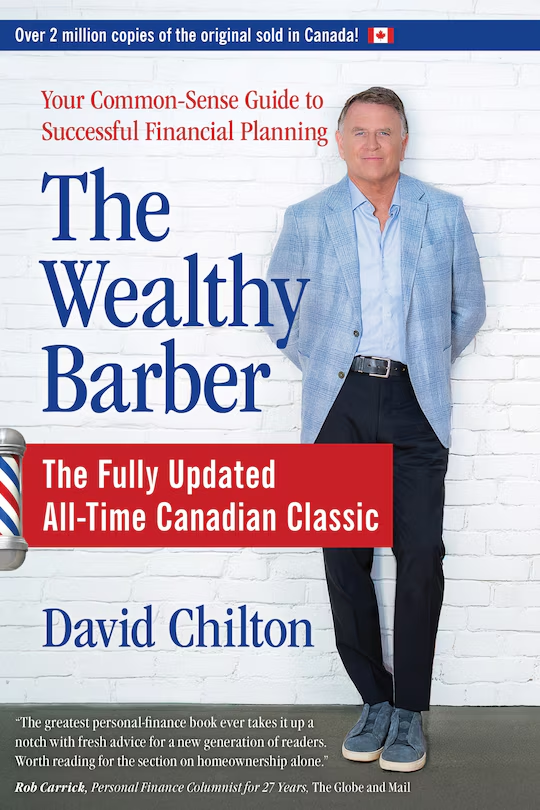
Engaging book delivers financial literacy in clear, enjoyable lessons: The Wealthy Barber (2025)
In this latest update of The Wealthy Barber, author David Chilton has a brother, sister, and their friends – all in their 20s and 30s — learning the ropes of personal finance from the famed Roy Miller, aka The Wealthy Barber.
Despite the surprising twist of everyone in the book being fans of both the Detroit Tigers and Lions, the friends learn key lessons about life and finance in a series of group sessions with Roy.
Roy, the book explains, was forced to drop out of university to look after his mom and siblings, and took over the family barber shop in Sarnia. A lesson he himself learned was to pay attention to successful people, and to learn from them the tricks of living within one’s means while saving for the future. He was happy to pass on his knowledge to a younger generation, including Matt, sister Jess, and friends Kyle and Sourov.
Roy starts off by telling the group “you can do this,” writes Chilton. “There is absolutely nothing we’re going to cover that you’re not capable of fully understanding and implementing successfully. You can start managing your money very well quite soon.”
His first bit of advice, the book continues, is about “the golden rule: invest at least 10 per cent of all you make for long-term growth. If you follow that one simple instruction… someday you’ll be quite well to do.”
Roy also tells the group about “the magic” of compounding, noting that “when your returns build up and earn returns and then all that together earns returns… et cetera, et cetera,” that’s “where the magic happens.”
Saving, he tells the group, is crucial for most of us. “Unless you come from a very wealthy family or marry into one – both excellent strategies by the way – you’re going to have to save money. You’re going to have to spend less than you make. You’re going to have to live within your means,” the book continues.
As well, Roy explains, “the only way to save…(is) to pay yourself first,” the book notes. “The most effective approach is to have the money come right off your paycheque, or directly out of your bank account, before you have a chance to spend it.”
Asked why savings should be invested, rather than being left “under a mattress,” Roy explains to the group that their savings are like a snowball at the top of a hill… “we invest to get it rolling… to harness the power of compounding returns.” Your savings, like the snowball, get larger as they roll along, he notes.
Roy says that even those without any investment knowledge can do well by investing in index funds (such as exchange traded funds). Instead of trying to pick stocks, which Roy likens to finding needles in a haystack, “we’re going to buy the whole haystack. The whole market, or at least, all the big companies.”
He warns the young (future) investors to be careful about fees, as even a seemingly small two per cent charge can eat into the growth of your investments.
A later chapter points out the importance of starting earlier in life on the savings path. There’s a detailed section of the difference between saving in a registered retirement savings plan (where assets grow tax-free and aren’t taxed until withdrawn) and a Tax Free Savings Account (where after-tax money can be saved and withdrawn tax free).
On joining workplace pension plans, Roy says that many such programs offer matching contribution by employers. Roy tells Matt, a teacher, that he has “a tremendous benefit at work that the rest of us here aren’t blessed with — a wonderful pension plan.” A defined benefit pension plan, the book explains, can provide members with pensions that pay out “60 per cent or more of their last working year’s income!”
The book discusses the other workplace pension options out there, such as defined contribution plans and group RRSPs as being easy ways to save automatically for your post-work future, and how programs like the First Home Savings Account and Home Buyers’ Plan can help you buy a home.
Other ideas Roy Miller shares with the group:
- Buying a smaller house means you will have a smaller mortgage that you can pay off more quickly.
- Be careful with credit cards and lines of credit – “debt doesn’t just offset growing assets, it often becomes so expensive to service that future saving is squeezed out.”
- If you are having problems living within your means, find a way to make more money – such as getting a promotion or a second part-time job.
Roy’s final advice to his students “is simply this. Fancy tax shelters, far-out-of-the-money option contracts and meme stocks all make for great conversations at dinner parties. Forced saving, owning the thing that own the things and compounding returns simply make for great dinner parties.”
This is beautifully written, entertaining and engaging book that takes the mystery out of being in charge of your finances.
If you don’t have a workplace pension program to join, then the Saskatchewan Pension Plan may be just what you’ve been looking for. You decide how much to contribute – you can have an amount directly transferred to the plan from your bank account on payday, or make lump sum contributions, or transfers in from other RRSPs you have – and SPP does the heavy lifting for you.
SPP will invest your hard-saved loonies in our professionally managed, low fee pooled fund. When it’s time to retire, your options include the security of a monthly lifetime annuity payment or the more flexible Variable Benefit.
Check out SPP today!
Join the Wealthcare Revolution – follow SPP on Facebook!
Written by Martin Biefer
Martin Biefer is Senior Pension Writer at Avery & Kerr Communications in Nepean, Ontario. A veteran reporter, editor and pension communicator, he’s now a freelancer. Interests include golf, line dancing and classic rock, and playing guitar. Got a story idea? Let Martin know via LinkedIn.
Apr. 13: BEST OF THE BLOGOSPHERE
April 13, 2026More Canadians save, but many worry if they’re on target
Retirement savings in Canada offers us a good news, bad news story, writes Jim Wilson for Canadian HR Reporter.
Wilson reports that a recent Edward Jones Canada survey’s results suggest that Canadians “remain confused, anxious, and unprepared for life after work,” despite the fact that more of us are saving and joining workplace pension programs.
Of the 70 per cent of survey respondents who reported “negative emotions” about retirement savings, “40 per cent say they feel confused, 37 per cent are unsure they are maximizing their registered retirement savings plan (RRSP) opportunities, and 36 per cent are worried they are not contributing enough for a financially secure retirement,” Wilson writes.
The survey, he continues, uncovered a gap in knowledge about “retirement mechanics.”
“Fewer than six in 10 (56 per cent) of respondents understand the value of tax deductions and 55 per cent grasp the tax implications of withdrawals. Only 53 per cent feel confident about what happens when an RRSP matures, while 66 per cent say they understand the annual contribution deadline,” the article explains.
“What we’re seeing is a generation that knows they need to save for retirement but lacks the confidence that they’re doing it right,” Edward Jones Canada’s Julie Petrera tells Canadian HR Reporter.
The survey found that more Canadians (41 per cent versus 39 per cent) planned to contribute to RRSPs this year, with 15 per cent intending “to contribute the maximum,” Wilson reports. While nine per cent said they couldn’t afford to contribute, that’s better than the previous year, where 10 per cent said they wouldn’t, the article adds.
Wilson’s article then takes a look at some pension plan participation numbers from the Financial Services Regulatory Authority of Ontario (FSRA).
“In Ontario, workplace pension membership increased by more than 200,000 people in 2025, an average of 549 new members per day compared with 2024, according to data from the Financial Services Regulatory Authority of Ontario (FSRA),” the article reports.
“From those numbers, more than 175,000 people joined defined benefit (DB) plans (up six per cent) and more than 58,000 joined defined contribution (DC) plans (up nine per cent),” Wilson notes.
(In a DB plan, the benefit – or payout – is what’s “defined” by a formula that usually looks at your earnings and years of service in the plan. With DC, what is “defined” is how much money you (and sometimes your employer) contribute; your payout is based on how well the money has been invested when you apply to collect it.)
However, that good news is tempered a bit by the fact that the FSRA research found “that eight in 10 respondents have not fully developed a retirement plan and 66 per cent have not calculated how much money they will need in retirement,” Wilson reports.
“One in two cannot recall the last time they spoke to someone about saving, and 50 per cent of pension members do not read their annual pension statement, based on a survey of 1,000 adult Ontarians conducted in 2024,” he adds.
The article concludes by going over some of the steps HR departments can take to help employees on their retirement journey, particularly in starting the conversation about the retirement program early.
If you don’t offer a workplace pension program for your team, the Saskatchewan Pension Plan may be just what you’ve been looking for to attract and retain top talent.
Employers can choose to offer SPP to their employees – several options are available (Pensions Plans for Businesses | Employee Pension Plans). In all cases, the bulk of the administrative work, such as delivering annual statements and tax slips, is handled directly by SPP.
SPP is also a great “do it yourself” savings program for those among us who don’t have a workplace pension program.
Check out SPP today!
Join the Wealthcare Revolution – follow SPP on Facebook!
Written by Martin Biefer
Martin Biefer is Senior Pension Writer at Avery & Kerr Communications in Nepean, Ontario. A veteran reporter, editor and pension communicator, he’s now a freelancer. Interests include golf, line dancing and classic rock, and playing guitar. Got a story idea? Let Martin know via LinkedIn.
Apr. 9: Investing During Times of Turmoil
April 9, 2026
Investing during times of world turmoil – what strategies are out there?
There’s no question – amid wars around the globe and a tricky trade war here at home – that we are living in unusual times.
What, if anything, should investors be doing during this latest bout of world turmoil? Save with SPP took a look around to see what strategies commentators are suggesting to ride out the storm.
Writing in The Globe and Mail Gordon Pape suggests taking “part profits,” or selling off some of your holdings.
“I don’t like selling in times of adversity. In fact, most financial experts suggest the opposite course: buy when prices are weak. But we’ve enjoyed strong stock markets in recent years, and you may hold securities that have more than doubled in value, even after last week’s pullback. Taking some of that money off the table and holding it in reserve in case the situation further deteriorates isn’t a bad idea,” he suggests, adding that you should first “check out tax consequences” and not “overdo it.”
He suggests we “check out commodities. Wars are bad news for stocks and bonds. But they can lift commodity prices, as we’ve seen with oil and gas.”
Keep an eye out for “special situations,” or companies that are doing well because of the crisis, such as energy stocks (due to impacts on oil shipping). He adds that we should consider holding some gold, as the precious metal can be a hedge against inflation and is considered a “safe haven” investment. He concludes by suggesting we all keep a bit more money in the U.S dollar, as it is “holding up well so far. Part of your cash holdings should be in greenbacks.”
He suggests things “will get better, so keep your cool and take advantage of situations as they arise.”
Writing in the Financial Post, Peter Hodson of 5i Research suggests one strategy is to be contrarian, and “buy the fear.”
“When investors panic we will often start buying. It has proven to be a good strategy, since every market downturn has ended at some point,” he continues. Sectors like energy may do quite well in these times, he adds.
“Oil of course is always a strategic asset during times of war. In the current conflict, the threat of the Strait of Hormuz closing has resulted in a big spike in oil prices. The energy sector was already doing well before this war started but has picked up steam since then,” he writes.
Gold, he concludes, “can be a good place to hide out when worried about global events, financial crises, or wars.”
An article from MoneySense from three years ago makes some still-valid points.
Alan Small writes that there is often “not a lot” investors can do when faced with a time of crisis.
“When markets sell off for reasons that are more temporary than related to economics and performance, it’s important to take emotion out of decision-making and not go into panic mode about your investments,” he writes. “Markets may dip, but they don’t usually collapse. It’s possible your portfolio’s value may drop for a period of time. In the past, after a crisis has ended—and regardless of the outcome—the markets have regained stability, and investment returns have bounced back.”
“My best advice in the face of a world crisis: Stay calm, take a deep breath and focus on the fundamentals,” he advises.
Before adopting any new investment strategy it is a very prudent idea to talk to your financial adviser. If you don’t have a financial adviser, now might be a very good time to get one and leverage their experiences with managing through things like the Tech Wreck, the World Financial Crisis and the COVID-19 Pandemic.
If you’re not experienced with managing money, but want to save for retirement, the Saskatchewan Pension Plan might be a valuable saving partner. SPP is open to any Canadian who has registered retirement savings plan room.
You can contribute any amount you choose to the plan (up to your annual RRSP limit) and can transfer in any amount from other RRSPs you might hold. Once SPP has received your savings dollars, our job is to grow them via investment in our professionally managed, low-cost pooled fund.
At retirement, your job is to receive your grown savings as income, with options including the security of a lifetime monthly annuity payment or the more flexible Variable Benefit.
Check out SPP today!
Join the Wealthcare Revolution – follow SPP on Facebook!
Written by Martin Biefer
Martin Biefer is Senior Pension Writer at Avery & Kerr Communications in Nepean, Ontario. A veteran reporter, editor and pension communicator, he’s now a freelancer. Interests include golf, line dancing and classic rock, and playing guitar. Got a story idea? Let Martin know via LinkedIn.
Apr. 6: BEST OF THE BLOGOSPHERE
April 6, 2026Six ways to augment the modest retirement benefits Canada provides
Writing for Money Canada, Vawn Himmelsbach warns that federal government retirement benefits alone don’t provide much income.
“Canada Pension Plan (CPP) and Old Age Security (OAS) provide an important base for retirement income — but for many Canadians, they won’t provide enough support on their own,” she warns.
It’s apparent, her article continues, that most of us are assuming CPP and OAS will allow us to live adequately post-retirement, since a recent Canada Pension Plan Investment Board survey found “that the majority of adults (73 per cent) expect to or already rely on government benefits to cover their basic retirement income.”
But she continues, CPP and OAS “were never intended to fully replace your earnings while in the workforce but rather supplement it. Most retirees need additional sources of cash flow to maintain their lifestyle — and to protect themselves if one income stream falls short.”
Even if you are getting both, the income they provide (CPP maximum is $1,507.65 and full OAS is $742.31, with most people getting less than the full amount), the amounts “often fall well below what most retirees actually spend on basic expenses each month. Housing, food, transportation and healthcare costs can quickly exceed government benefit payments — especially for those who rent, carry debt or live in higher-cost areas,” she explains.
Himmelsbach then turns to six ways you can add income to that modest CPP/OAS base.
Having a workplace pension is an excellent starting position, she notes.
“If you’re one of the 48 per cent of Canadians that has a workplace pension, it can form a strong foundation to your retirement income,” she writes. However, workplace pensions, she adds, are “becoming less common outside the public sector.”
That brings us to the second category – personal savings.
“For many Canadians, personal savings do most of the heavy lifting in retirement. That usually means drawing income from a Registered Retirement Savings Plan (RRSP), Tax-Free Savings Account (TFSA) or both,” she reports.
RRSPs, she explains, “offer tax-deferral while you’re working, but withdrawals in retirement are taxable. That can make timing and withdrawal strategy especially important, particularly once RRSPs are converted to Registered Retirement Income Funds (RRIFs) and minimum withdrawals begin.”
“TFSAs work differently,” she adds. “Withdrawals are tax-free and don’t affect government benefits like CPP and OAS.”
Another way to save, she writes, is via Guaranteed Investment Certificates (GICs) and High Interest Savings Accounts (HISAs).
“GICs offer a guaranteed return over a fixed period, which can make them useful for planning specific expenses or building short-term income. The trade-off is access: Your money is typically locked in until the GIC’s maturity date, unless you choose a cashable option,” she explains.
“HISAs offer more flexibility. While returns may be lower than long-term investments, they allow retirees to access funds quickly, without worrying about market swings,” she notes.
There’s another category worth considering – dividend-paying investments, she continues.
“Dividend-paying investments can provide a steady income stream on top of potential growth in the long run. For retirees, that regular cash flow can help reduce the need to sell long-term investments to cover everyday expenses,” she reports. “Dividends from eligible Canadian corporations also receive favourable tax treatment through the dividend tax credit when they’re held in a non-registered account, which some retirees might find more appealing over interest income.”
Another way to augment monthly government retirement benefit income is by converting some of your savings to an annuity, Himmelsbach suggests.
“Annuities can provide something many retirees value: certainty. In exchange for a lump sum, an annuity pays out a guaranteed income stream, often for life. That predictability can make budgeting in retirement much easier,” she writes, adding that “some retirees use them to cover essential expenses — like housing, food and utilities — so those costs are always met, regardless of market conditions.”
Her final suggestion is real estate income.
“Becoming a landlord can provide steady rental income, but it also means dealing with maintenance, vacancies, taxes and tenant issues,” she states.
“Owning rental property can also tie up a large amount of capital. Carrying costs, repairs and property taxes don’t stop just because you’re retired. And income isn’t always predictable — especially during economic slowdowns,” she adds.
She concludes this informative piece by underscoring the idea that you will need multiple income streams in retirement.
“The goal isn’t to chase returns, but to assemble a mix of income streams that can support your lifestyle, manage risk and last throughout your sunset years. As with any major financial decision, it’s always in your best interest to consult a financial professional to help you reach your goals,” she states.
Did you know that members of the Saskatchewan Pension Plan can convert some or all of their accounts to a lifetime annuity – an option that carries no cost or monthly fee?
No matter which type of SPP annuity you choose (they are all detailed here in the Pension Guide), you will receive a monthly payment for life. Some options provide benefits for qualifying survivors too – the choice is yours.
See how SPP is helping deliver retirement security for Canadians – check out SPP today!
Join the Wealthcare Revolution – follow SPP on Facebook!
Written by Martin Biefer
Martin Biefer is Senior Pension Writer at Avery & Kerr Communications in Nepean, Ontario. A veteran reporter, editor and pension communicator, he’s now a freelancer. Interests include golf, line dancing and classic rock, and playing guitar. Got a story idea? Let Martin know via LinkedIn.
Apr. 2: Impact of Adult Kids Moving Home
April 2, 2026
Many impacts for parents when adult kids are forced to move back home
Work is done, the mortgage is paid, debt is finally under control – and then the nest, empty for years, fills up again.
What are some of the impacts on retired people when adult children – perhaps due to housing difficulties, unemployment, illness or other reasons – move back home with their senior parents? Save with SPP decided to have a look around to see what people are saying about this growing trend.
Writing for MoneyWise, Chris Clark reports that “a volatile economy, high student debt and rising housing prices have seen many adult kids `boomerang’ back to their childhood homes in droves.”
Clark cites recent research from Thrivent that found “soaring real estate costs, among other factors, have made it increasingly difficult for young adults to afford their own homes — forcing many to return to their parents as a temporary solution while they save money or search for more affordable options.”
And, Clark continues, a recent USA Today poll found that “65 per cent of parents admitted to providing some sort of financial support to their kids between the ages of 22 and 40… with parents shelling out an average $718 USD a month to support their adult kids.”
There are financial consequences for parents of boomerang kids, Clark notes.
“When kids move back in, household expenses inevitably increase. Parents may find themselves paying higher utility bills, buying more groceries, and covering additional living expenses. These increased costs can strain the household budget, especially for parents who are nearing retirement or are already retired,” Clark notes.
“Parents may dip into their retirement funds or delay their retirement plans to accommodate the needs of their adult kids — potentially jeopardizing their financial security in the long term and draining the money available for their golden years,” Clark adds.
The Times of India expands on the consequences for parents.
“The increased household costs for groceries, utilities, and healthcare are taking a toll, with some families opting to create cost-sharing arrangements,” the publication reports.
Financial advisor Alex Gonzalez tells the publication that “taking care of your adult children is an act of love, but it requires a delicate balance between a desire to help and your own financial planning.”
Indeed, the article continues, “38 per cent of parents report that their long-term savings, including retirement contributions, have been impacted by the return of their adult children. Another 39 per cent say their short-term financial goals, such as saving for vacations or home renovations, have also been affected.” The article refers to U.S. statistics.
The Times article concludes with this advice.
“As the number of boomerang kids continues to rise, American families are adjusting to the new financial realities of multigenerational living. While the return of adult children can offer emotional support, it is reshaping household dynamics and requires careful financial planning to navigate successfully.”
An article on the Focus on the Family Canada website provides some guidelines that were set by the author and his wife when their 22-year-old son faced homelessness after bouncing around and living with friends.
They set rules, such as no guests were to be allowed when the parents weren’t home, that the parents have the final word on house rules, that the son would get a job, pay his own way, and “equip himself for the future.”
While things were difficult at first, the author notes, their son has generally followed the rules and is growing more independent.
“For the first time, (our son) is making his own doctor appointments, paying his bills and taking charge of his life. In the past, we would have done all of these for him. Our decision to maintain a `hands-off’ policy has nudged Brad toward greater independence.”
Perhaps having an adult child move home will present you with an opportunity to get them thinking about long-term saving.
If your child does not have a pension plan through work, the Saskatchewan Pension Plan may offer a helping hand in the savings department. Members decide how much they want to contribute annually – the plan is open to any Canadian with available registered retirement savings plan room.
Members can also transfer funds into SPP from any RRSPs they may have to consolidate the nest egg.
SPP does the heavy lifting from there, investing all contributed funds in our professionally managed, low-cost pooled fund. When it’s time to retire, member options include the security of a lifetime monthly annuity payment or the more flexible variable benefit.
Check out SPP today!
Join the Wealthcare Revolution – follow SPP on Facebook!
Written by Martin Biefer
Martin Biefer is Senior Pension Writer at Avery & Kerr Communications in Nepean, Ontario. A veteran reporter, editor and pension communicator, he’s now a freelancer. Interests include golf, line dancing and classic rock, and playing guitar. Got a story idea? Let Martin know via LinkedIn.